CaseAtlas. 31,000+ ways to practice strategy.
A free, AI-powered case interview simulator. It writes an original case for the industry, function and difficulty you pick, scores your answers, and tells you what to fix first. I designed and built it solo in 2026, alongside ISB's executive program in product management, and used it to practice what the program teaches: deciding what to build, for whom, and why.
Case prep tools are expensive, fixed, and go stale.
Practicing business cases is how you get into consulting. The tools for it are subscriptions, typically $30 to $60 a month, built around a library of pre-written cases. The cases are fixed, the difficulty is fixed, and the industry and business problem are whatever the case writer chose.
The deeper problem is that a fixed library shrinks as you use it. Once you have seen a case, you have seen it. And most tools stop at the case itself: you read it, you answer it in your head, and nobody tells you whether your thinking was any good.
People in active prep, not casual readers.
I narrowed the audience on purpose: consulting and MBA candidates who are weeks away from interviews and practicing several times a week. They were also the people around me, so I could watch how they prepared.
- They mix paid platforms, PDF case banks and YouTube mock interviews
- Paid tools give them structure, but not variety
- Free resources give them variety, but no feedback
- What they are really buying is confidence that their thinking holds up, and a case alone does not give them that
That last point set the product's direction. The job is not "give me a case". It is "tell me whether I would have passed, and what to work on".
Not a case library. Not a chatbot. A practice partner that scores you.
| Alternative | Typical cost | Where it falls short |
|---|---|---|
| Coaching | $100 to 300 an hour | Real feedback, but not on demand and not affordable for daily practice |
| Case libraries | $0 to 200 a year | A finite set of cases and no scoring. Reading, not practicing |
| General AI chat | Varies | Will write a case, but with no consistent rubric and no memory of how you are improving |
| CaseAtlas | Free in early access | Original cases, a fixed scoring rubric, progress tracked across attempts |
Generator, case, evaluation.
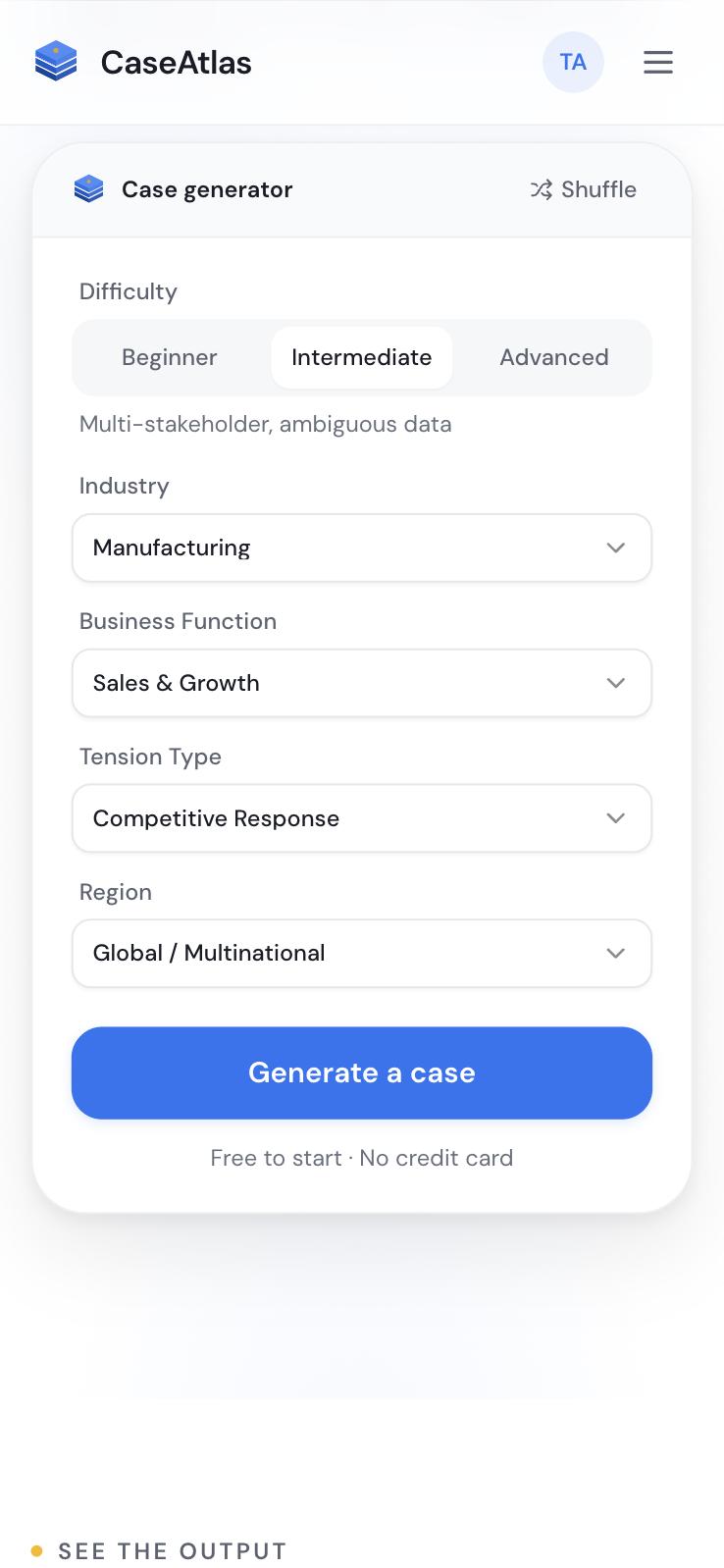
You choose a difficulty and four things about the case: industry, business function, the kind of tension at its heart, and region. That is 13 industries × 9 functions × 15 tension types × 6 regions × 3 difficulty levels, or 31,590 possible combinations, and each one is written fresh.
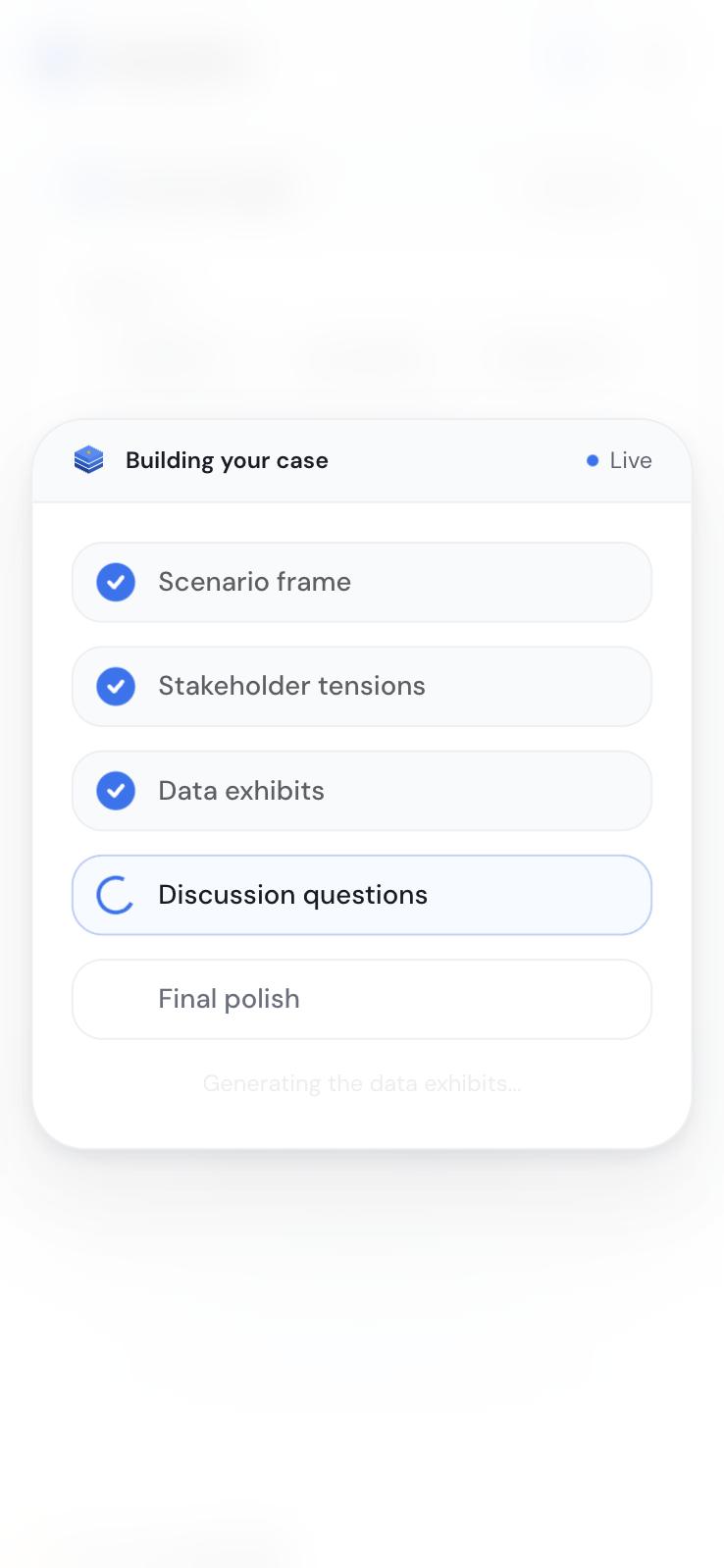
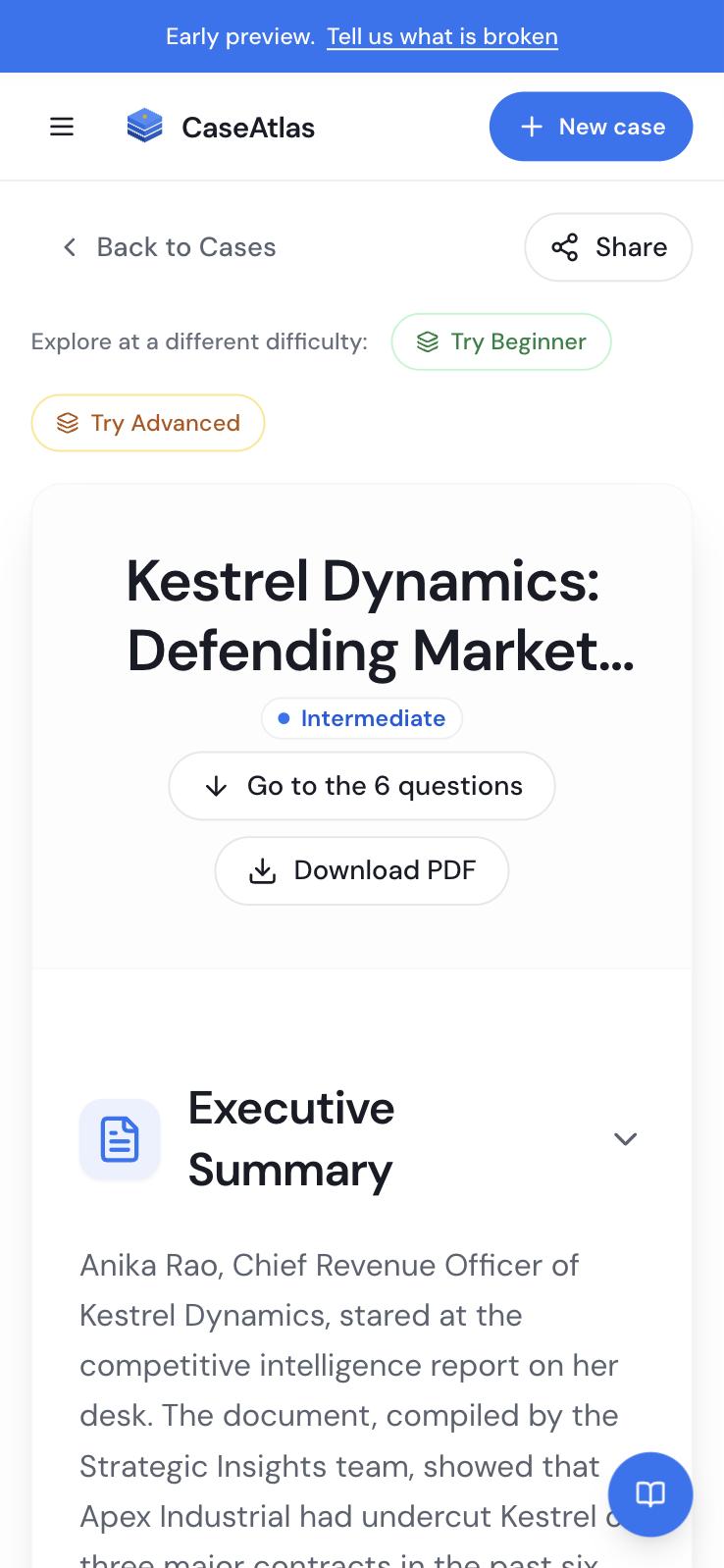
- The case. Executive summary, company background, the strategic challenge, stakeholder perspectives, data exhibits and a set of discussion questions.
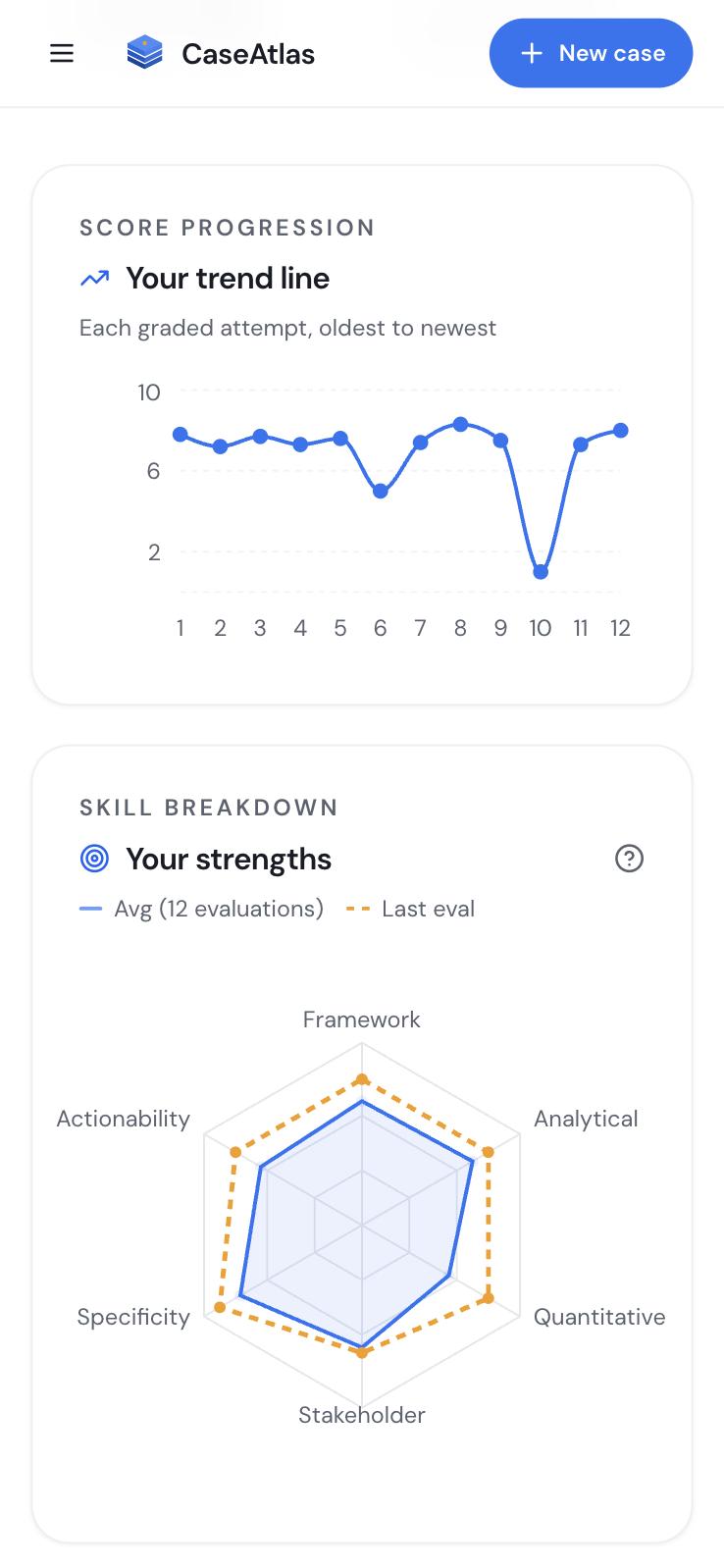
- The evaluation. Every answer is scored out of 10, then the whole attempt is rated on six skills: framework application, analytical depth, quantitative rigor, stakeholder awareness, case specificity and actionability.
- "Fix this first". One specific weakness, taken from your lowest-scoring answer, so you know where to start.
- Three attempts per case, and the same case at an easier or harder difficulty.
- Progress over time. A score trend and a skill radar that compares your latest attempt with your average.
- A 23-framework library, linked directly from the feedback, plus PDF export and private share links.


What I had, what I changed, and why.
The product today is not the one I first built. These are the changes that mattered, each one a response to something I saw or learned.
From a sign-in wall to "try it first"
Originally you had to create an account before you saw a single case. Now a visitor can generate two cases and get full scored feedback with no account. People have to feel the value before they will hand over an email address, and the value here only shows up after the first evaluation.
From a single score to a diagnosis
The first evaluation returned one number. A number tells you how you did, not what to do next. It became per-question scores, six rated skills, a "Fix this first" pointer and the option to reattempt. The feedback loop, not the case, is what brings someone back.
From 10 frameworks to 23, linked from feedback
I added a small framework panel as a reference. It turned out to change how people read a case: with frameworks in view they map the case against them instead of just reading. So I invested in what was working, grew the library, and made every framework named in feedback open in place.
From placeholder samples to real generated cases
The sample cases are the first proof of quality a visitor sees. Hand-written placeholders made a promise the product might not keep, so I replaced them with real output from the generator.
From "free on principle" to free with a purpose
I started out treating free as a principle. I now treat it as a strategy: free in early access, capped at 20 cases a month, to get the first 100 people using it. Their feedback shapes the next release, and their behaviour shows me how the product is really used, when, and by whom. Every case costs money to generate, so the cap keeps that affordable while I learn.
The AI model, swapped three times
I moved from a small Mistral model to a larger one for reliability, then to DeepSeek. Because every AI call reads its model from one file, each switch was a decision about quality and cost rather than a rebuild.
Share links, private by default
Shared cases were open to anyone with the link. A user's answers and scores are personal, so sharing became private by default, as part of a wider security pass before opening the product up.
Three reasonable ideas, cut on purpose.
Leaderboards and peer comparison
An obvious way to add stickiness. I cut it because it changes the incentive. Chasing a visible rank is not the same as getting better at case interviews, and the two diverge quickly. The product stays in the service of improvement, not performance.
A fixed case library
Curating a library would turn CaseAtlas into the kind of product it was built to replace, and put it in a catalog-size race against platforms that have been building theirs for years. The handful of sample cases on the site are a showcase of quality, not the product.
A paywall on day one
Gating evaluations or advanced cases was the obvious early move. I held off because I do not yet know what the product is worth to the people using it, and a paywall would have cut off the usage I need to find out.
Building the app was easy. Getting good cases every time was not.
A prompt that produced excellent technology cases would produce thin, generic ones for niche combinations. The output looked structured but had no real analytical tension. Four things fixed it.
A strict contract for the output
The model has to return a case in a defined shape, section by section. Output that does not match is rejected, which pushes the model toward specifics, because vague answers tend to fail the check.
Automatic retries
Models occasionally return something malformed. The system retries up to two times before showing an error, and the user almost never sees it.
Difficulty built into the instructions
Each level has its own instruction set. Beginner cases state the problem clearly. Advanced cases carry ambiguity, conflicting priorities and trade-offs with no clean answer.
Speed where it matters, care where it matters
Writing a case is long and needs to be fast, so it runs with the model's extra reasoning switched off. Scoring is short and needs to be right, so it runs with reasoning switched on.
The lesson: the model is one stage in a pipeline, not the whole product. Reliability comes from the structure built around it.
Free for now. Priced once I know what it's worth.
CaseAtlas is free in early access: the full product, 20 fresh cases a month, no credit card. Paid plans come later, and early users keep their access when they do.
That order is deliberate. Setting a price now would mean guessing at what candidates will pay. The first 100 users will show me which parts they return to and how often they hit the monthly cap, and that is the evidence a price should be built on.
The numbers that will tell me if it's working.
The product is in early access, so I am not going to quote usage figures yet. These are the measures I will watch as the first 100 users arrive, and what each one tells me.
| Measure | What it tells me |
|---|---|
| Graded attempts per user, per week | The main one. A case that is generated but never answered delivered no value |
| Guests who finish a first evaluation | Whether "try it first" gets people to the moment the product makes sense |
| Guests who create an account | Whether two free cases are enough to earn a sign-up |
| Reattempt rate, and score change between attempts | Whether the feedback is specific enough to act on |
| Users who reach the 20-case cap | Who the heaviest users are, and the first signal of what a paid plan should include |
| Cost per generated case | Whether free early access stays affordable |
Lessons from shipping an AI product.
The job is rarely the feature people name
People said they wanted more cases. What they needed was to know whether their thinking held up. Building for the second one changed the whole product.
Let people reach the value before you ask for anything
Removing the sign-in wall cost me some control and gave visitors a reason to stay. The ask belongs after the proof.
Free is a decision with a job to do
It is easy to call free a principle. It is more useful to say what it is for, who it is for, and what would make you change it.
Scope discipline is how you ship
No leaderboard, no fixed library, no paywall yet. Cutting them is what let one person ship a product that does its one job well.
A solo product. The whole job.
Want to try it? It's free.
Live at caseatlas.org. No install, and no sign-up needed for your first two cases.